
Industrial Intelligence Blog · Condition Monitoring
Condition Monitoring vs Predictive Maintenance: A Practical Difference
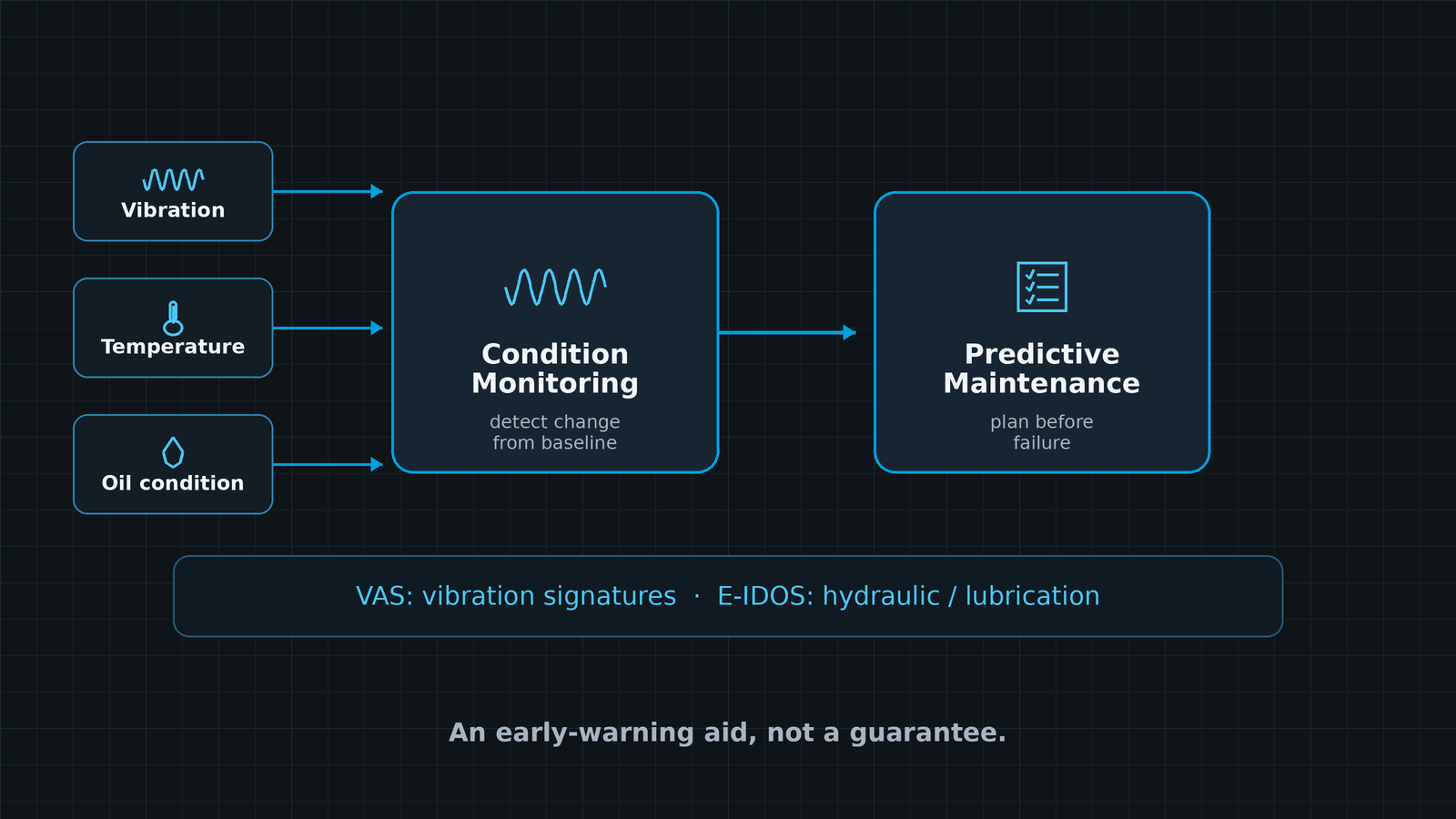
"Condition monitoring" and "predictive maintenance" get used interchangeably in sales decks, which sets the wrong expectation on the floor. They're related, but they're not the same thing — and treating either as a guarantee of "no more breakdowns" is the fastest way to lose trust in the whole programme.
What each one actually is
- Condition monitoring is watching health signals — vibration, temperature, oil condition — to detect when a machine's behaviour changes from its normal baseline. It tells you something is shifting.
- Predictive maintenance is what you do with that — using the monitored signals (and, where appropriate, models and history) to estimate that a problem is developing, so maintenance can be planned before a failure rather than after.
Put simply: condition monitoring is the foundation; predictive maintenance is the decision layer you build on top of it. You can't do credible predictive maintenance without trustworthy condition data underneath.
What they can — and can't — do
- Can: give earlier warning of a developing problem, so you plan a repair on your terms instead of reacting to a breakdown.
- Can: improve the chance of earlier action — fewer surprises and better-timed maintenance when the signals are meaningful and acted on.
- Can't: guarantee a machine won't fail. Not every failure announces itself, and not every signal change is a fault. These tools are an early-warning aid, not a promise.
- Can't: act on their own — someone still has to own the alert and decide what to do.
Where it applies
Rotating and fluid equipment is often where this is easiest to justify: motors, pumps, fans, spindles, gearboxes (vibration), and hydraulic/lubrication systems (oil and fluid condition).
Common mistakes teams make
- Selling it as a guarantee. "Predictive" doesn't mean certain. Frame it as earlier warning, and the programme survives its first surprise failure.
- Buying sensors with no owner for the alerts. Data nobody acts on is cost, not value.
- Expecting it equally on every machine. Different machine classes need different measurements and baselines.
- Skipping the baseline. Without a normal-behaviour reference and a measurement schedule, a "change" has nothing to be measured against.
How Elpis approaches it
The Vibration Analyser System (VAS) captures vibration signatures, with the measurement schedule and analytics configured per machine class — so a spindle and a pump are watched in the way each needs. E-IDOS monitors hydraulic and lubrication condition. Positioned honestly, these are an early-warning trigger, not a guarantee — they surface a developing change earlier so your team can act, and they sit beside your existing maintenance practice and CMMS, feeding the same canonical data path. More in the Condition Monitoring capability overview.
Where to start
Pick the few machines whose unplanned failure hurts most, define what "normal" looks like for each, and decide who acts when a signal shifts.
See it on your own floor
Explore the platform, or get in touch to scope condition monitoring on your critical machines.
Elpis IT Solutions builds an Industrial Intelligence Ecosystem — from shop-floor signal to enterprise decision. Operating across India and the Middle East.