
Industrial Intelligence Blog · Operational Intelligence
What Is EREMOS V2? From Machine Signals to OEE You Can Trust
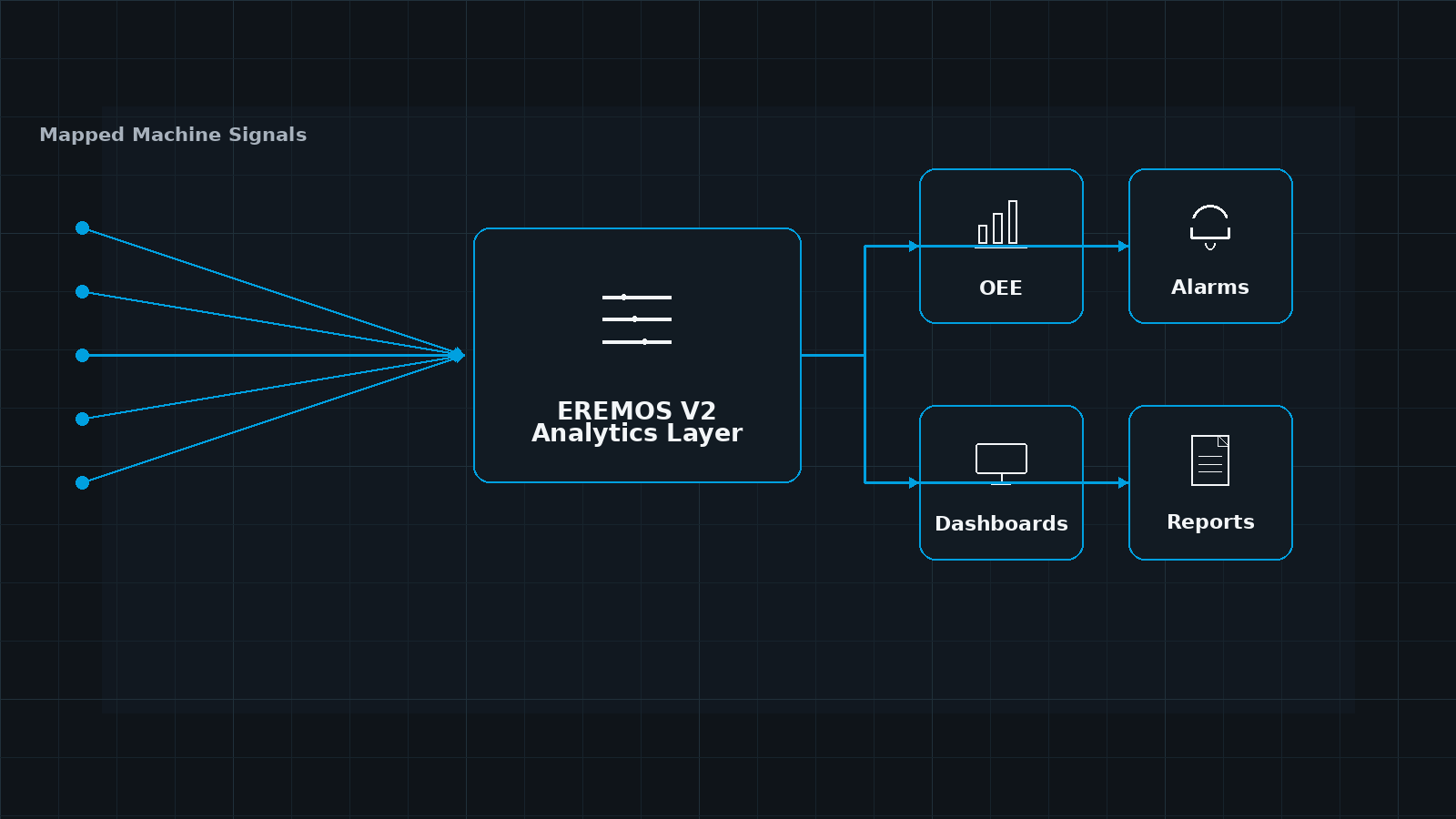
Collecting machine data is only half the job. A stream of raw signals isn't a decision — and a dashboard built on numbers nobody can trace is worse than no dashboard, because people stop believing it. Many plants still calculate OEE in a spreadsheet, by hand, with definitions that quietly differ from one shift to the next.
What EREMOS V2 actually is
EREMOS V2 is the operational intelligence layer — it turns clean machine signals into OEE, alarms, dashboards, and reports. It models the industrial hierarchy — from plant and line down to equipment, sub-equipment, and tags — with first-class devices, tags, and quality codes. It computes OEE from explicit machine states, and it does so against your own definitions of those states, not a vendor preset. It carries persistent alarms with incident workflows, configurable alerting on the channels your team already uses, and per-tenant isolation. Dashboards can be configured by device class, so mixed fleets can be represented with views that fit each machine type.
Where it applies
Single plants that want trustworthy OEE and downtime visibility; multi-line operations that need one consistent view; multi-site groups that want each site isolated but comparable; mixed fleets where CNCs, presses, and utilities coexist on one model.
What makes OEE trustworthy?
OEE is only as good as the inputs and the rules behind it. The things that make a number defensible:
- Traceable signals — every figure traces back to a real, named value from a specific machine at a specific time.
- Customer-owned state definitions — running, planned stop, unplanned stop, idle, setup, and inspection are defined by you, to match how your plant actually operates.
- Timestamp discipline — consistent, reliable time across sources.
- Quality codes — so a bad or stale reading is flagged, not silently averaged in.
- Downtime categories — planned vs unplanned, captured consistently.
- Setup and inspection handling — these states modelled explicitly, not lumped into "stopped."
- Production count and quality rules — good vs total counts defined the way your process counts them.
Common mistakes teams make
- Accepting a vendor's preset OEE formula. If the definition of "running" isn't yours, the number won't match how your plant operates — and operators will reject it. The software should apply your rules, not assume the correct definition for you.
- Building the dashboard before fixing data quality. A chart on bad inputs is a liability. Timestamp, source, and quality codes come first.
- One view for every machine type. Unlike machines need unlike views.
- Expecting it to be a full MES. It isn't, and treating it as one sets the wrong expectation.
How Elpis approaches it
EREMOS V2 builds its math on traceable signals and applies your state definitions and counting rules. It runs beside your MES, historian, and other systems — not as a replacement for them. And it's fed by EdgeConnect's output, so the data arriving is already mapped into a consistent model across supported sources.
Bring your current OEE definition and the lines you want to see first — more in the Operational Intelligence capability overview.
See it on your own floor
Explore the platform, or get in touch to walk through your controller mix.
Elpis IT Solutions builds an Industrial Intelligence Ecosystem — from shop-floor signal to enterprise decision. Operating across India and the Middle East.